The New Studio Museum in Harlem

Exterior of the Studio Museum in Harlem's original location at 2033 Fifth Avenue, c. 1968
Exterior of the Studio Museum in Harlem's original location at 2033 Fifth Avenue, c. 1968
In the 1960s movements for equality and freedom, such as the civil rights movement at home and the postcolonial liberation movements abroad, rocked the world. In response to these upheavals that brought people, young and old, into the streets in places such as Harlem, Newark, Chicago, Birmingham, and Watts, artists captured the hue and cry of this incandescent moment. Visual artists, joined by musicians and writers, launched radical efforts to mix genres and disciplines, creating works of art that resonated with the fervor and fury of the moment, as well as envisioning what might emerge from the tumult.
Artists also embraced the spirit of change to advocate for transformations within institutions by forming coalitions and collectives to protest the exclusion of artists of color and women from mainstream collections and exhibitions. Others, inspired by these seismic shifts, sought to create new institutions. It is within this global and local crucible of political upheaval and social transformation that Harlem’s Studio Museum took shape.
In the 1950s and 1960s Black communities across the United States were also experiencing the pressures of “urban renewal” that mowed through their neighborhoods in a devastating fashion that writer James Baldwin dubbed “Negro removal.” Residents were trapped in substandard and overpriced housing and endured relentless police harassment. One example of a radical response to these urban attacks came in 1965 when essayist, poet, and activist June Jordan, who earned her degree in environmental design from Barnard College, published a plan for Harlem public housing titled “Skyrise to Harlem” with architect Buckminster Fuller. Their expressive, towering high-rises made of woven basket-like facades sprout across Harlem with a magisterial expression of collective living. “Skyrise to Harlem” reimagined Uptown as a space of refusal and liberation—“Every room has a view,” Jordan wrote about the design.
The Studio Museum seeded the production, curation, and exhibition of contemporary art by Black artists amid the everyday spaces of Harlem.
Within this creative landscape, the founders of the Studio Museum launched a unique project of institutional transformation. In a bold move of invention, this group grafted the spaces of the artist’s studio—the study and workroom—into the spaces of the museum—the institution’s collections (which would come later for the Studio Museum), education centers, and galleries. The founders opened the Museum’s inaugural studios and galleries at 2033 Fifth Avenue between 125th and 126th Streets. Here, adjacent to the windows of a corner store, the displays of a clothing boutique, and spaces of beauty and style found at the Beauty World of Otto, the Studio Museum seeded the production, curation, and exhibition of contemporary art by Black artists amid the everyday spaces of Harlem.

June Jordan and R. Buckminster Fuller, Skyrise to Harlem, 1965; reproduced in June Meyer, “Instant Slum Clearance,” Esquire 63, no. 4 (April 1965)
The Studio Museum’s new expanded 82,000–square–foot, seven-floor building continues its unique mission to serve as a laboratory and forum for artists of African descent. The Museum's new home, designed by Adjaye Associates with Cooper Robertson serving as executive architect, takes its cues from Harlem’s vibrant public spaces—the street, the sanctuary, the stage, and the stoop. These familiar architectural precedents can be experienced in various locations around the museum.
One of the first encounters visitors have with these elements occurs in the entry-level lecture hall—a flexible assembly space called “the Stoop” designed to host talks and performances. The operable bank of glass doors at the upper level of the Stoop can open directly onto 125th Street, welcoming the public into events. With its warm wooden tiered seating, the Stoop also serves as the museum’s sanctuary, a multiuse place for visitors to rest and reflect, or gather and converse.
These lively areas connect directly to a multistory central stair clad in pebbled gray terrazzo with satin brass balustrades accentuating its walls. The volume of the unfolding gray ribbon brings museumgoers into a vertical “street” whose gallery walls will display large-scale artworks bathed in natural light cascading from a skylight. The central stair’s lower-level landing forms another “stoop,” which overlooks the cafe and tiered seating of the lecture hall, and which can be commandeered as part of the “stage.” When visitors stand on the entry-level stair landing, another stoop condition, they are treated to a panoramic view through the museum that extends across 125th Street and the plaza at the Adam Clayton Powell Jr. State Office Building to the stoops of the historic brownstones on West 126th Street. At street level, this perspective, like the windows, stairs, and stoops in Romare Bearden’s urban collages, draws the museum into the assemblage of cityscapes connecting with the kinetic flow of passersby that vivifies the neighborhood.

Romare Bearden, Untitled, 1972. Offset print, 24 3/4 × 35 1/4 × 1 1/2 in. Studio Museum in Harlem; gift of Lowery Stokes Sims 2003.21.3. Photo: John Berens
As the museum’s vertical ribbon of the central stair ascends, it weaves together seven floors of exhibition and educational spaces, including three state-of-the-art galleries and studios for the Museum’s hallmark Artist-in-Residence program. The museum’s spatial order, what architects call its “typology,” or the organizational logic of programmatic spaces that determines its function as a museum, echoes Marcel Breuer’s modernist icon for the Whitney Museum for American Art on Madison Avenue, completed in 1966. The precedent for the Studio Museum’s vertical ribbon can be found in how Breuer crafted a Brutalist concrete central stair that serves as a vertical spine connecting the building’s multiple levels. The exterior volumes of both museums comprise stacked boxes, clad in gray concrete panels at the Studio Museum and tiers of gray granite for the Breuer building, that appear to defy gravity when seen from their streetscapes. The Studio Museum’s new building, however, takes advantage of its volumetric composition to form large-scale niches and platforms for the display of public artworks on its main facade on West 125th Street and secondary facade on West 124th Street.
These gestures affirm the Studio Museum’s decades-long connection to its surrounding neighborhood, as well as Harlem’s rich architectural and urban history.
The entrance also reveals a difference in attitude to the street level. To enter the former Whitney, for instance, visitors crossed a bridge surrounded by a triple-height void. This dramatic transition inaugurated a retreat from the din of the city into the contemplative spaces of the gallery. By contrast, the Studio Museum’s new entrance is framed by the store on one side and the ramp to the lecture hall on the other. All of these entry-level spaces welcome the liveliness of the city into the museum at every opportunity. At strategic moments in its upper-level spaces, for example, visitors encounter large apertures, in the spirit of the oculi protruding from the Breuer’s facade, that frame views of unique architectural features and urban perspectives of nearby Harlem buildings. When museumgoers arrive at the top-level outdoor terraces, they find spaces to gather amid Harlem’s unique skyline. These gestures affirm the Studio Museum’s decades-long connection to its surrounding neighborhood, as well as Harlem’s rich architectural and urban history.
Like the sea changes of the 1960s, this is a vital moment for artists to feel connected to the communities where they work and to whom they speak. Novelist Toni Morrison once asserted that when social discord appears on the horizon, “it is the time when artists go to work—not when everything is fine, but in times of dread.” With this new building, the Studio Museum is once again one place where artists can “go to work,” catalyzing and imagining transformation.

Exterior view of the Studio Museum in Harlem’s 125th street facade. Photo: © Dror Baldinger FAIA
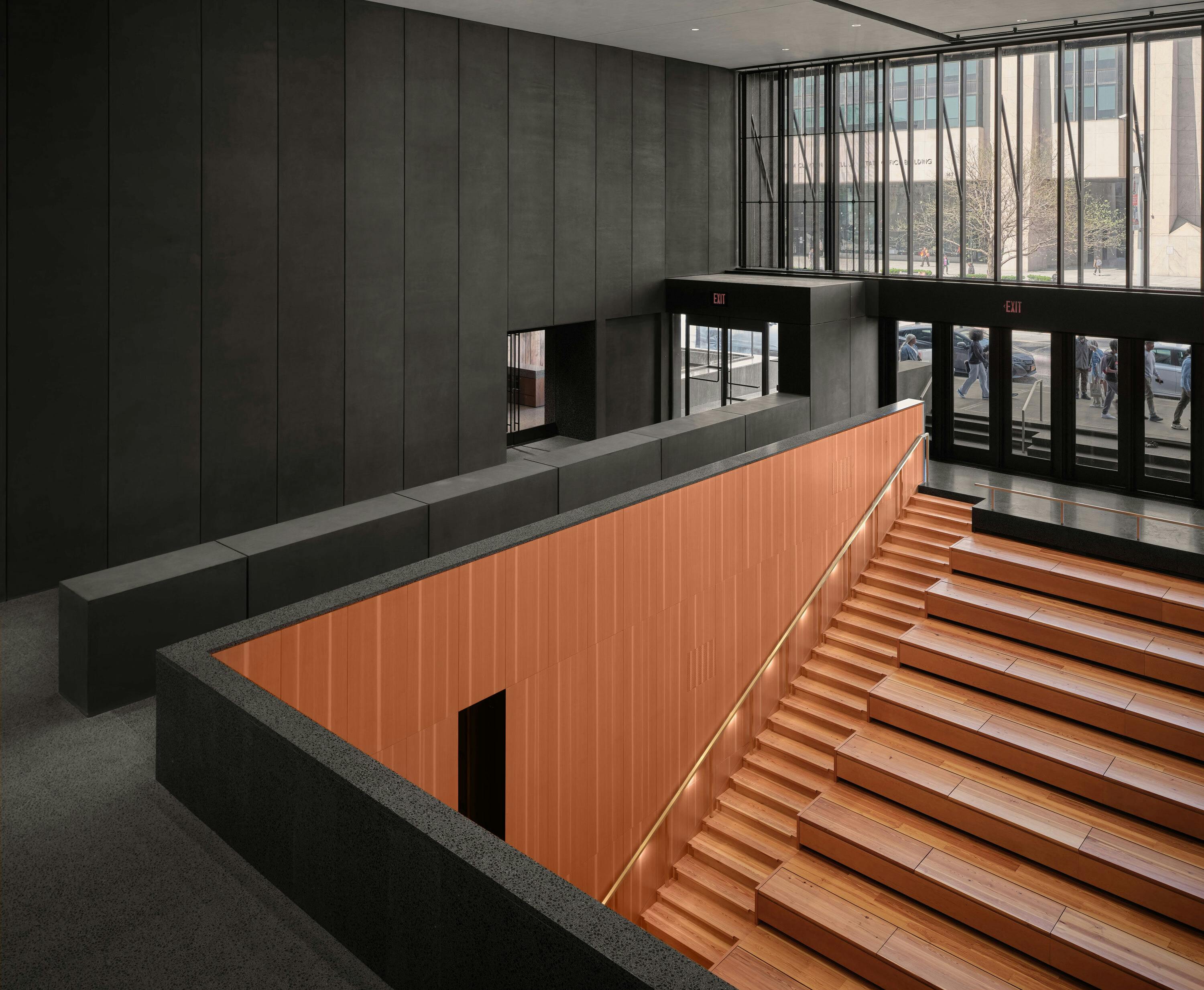
Interior view of the Studio Museum in Harlem’s new building, featuring the Stoop and the lobby. Courtesy Studio Museum in Harlem. Photo: ©DrorBaldinger FAIA

Detail of the Grand Stair. Photo: © Dror Baldinger FAIA