Collection in Context: Sports
2026 is a big year for sports, between the Winter Olympics, the World Cup coming to the Mexico, Canada, and the United States, and a groundbreaking labor agreement for the WNBA. From playground games to youth leagues, high school to college, and across numerous professional associations and inter-national competitions, sports are an integral aspect of contemporary culture. This Collection in Context explores how artists reference sports to explore race, history, gender, the body, and social life.

Mark Bradford, Untitled, 2009. Mixed media, papier mache, and collage, 9 1/2 in. diamters. The Studio Museum in Harlem; bequest of Peggy Cooper Cafritz (1947–2018), Washington, D.C. collector, educator, and activist 2018.40.41 © Mark Bradford. Courtesy the artist and Hauser & Wirth
In youth, sports can provide a space for early explorations of sociality, play, and bodily power. Ron Tarver’s The Basketball Game (1993) shows two young men on a court, one leaping while the other watches. Meanwhile, Mark Bradford’s Untitled (2009) depicts a lumpy, misshapen soccer ball, much like those found on dirt pitches and city streets around the globe, where joy and activity are unhindered by the quality of equipment.

Ron Tarver, The Basketball Game, 1993. Archival inkjet print, 23 1/2 × 28 1/2 × 1 1/4 in. The Studio Museum in Harlem; Museum purchase with funds provided by the Acquisition Committee 2017.21. Photo: Adam Reich
Professional athletes fine-tune their bodies to perform astonishing feats of strength, speed, flexibility, and coordination. Karon Davis’s Fix Me (2023) alludes to Alvin Ailey’s groundbreaking, genre-defying ballet Revelations (1960) and shows two dancers, one lifting the other overhead. In Deborah Willis’s Bodybuilder #4 (1998), a female subject is shown from behind, emphasizing her muscular back and her red painted nails. The work frames the athlete’s body as a site of immense power while alluding to the rigid beauty standards imposed upon Black women’s bodies.

Karon Davis, Fix Me, 2023. Plaster, steel, tulle, glass eyes, and chicken wire, 66 × 58 x 53 in. Studio Museum in Harlem; Museum purchase with funds provided by Kathryn and Kenneth Chenault 2024.22.1. Photo: John Berens

Deborah Willis, Bodybuilder #4, 1998. Chromogenic print, 19 1/2 × 15 1/2 in. The Studio Museum in Harlem; gift of the artist 2005.2.1. Photo: Zalika Azim
Some artists choose to depict known trailblazers, as with Carl Van Vechten’s portrait of Althea Gibson, who shattered color barriers in tennis as the first Black player to win a Grand Slam tournament, and in golf as the first Black competitor in the Ladies Professional Golf Association. In how i got over (2011), Henry Taylor illustrates high jumper Alice Coachman, the first Black woman to win an Olympic gold medal. Kori Newkirk’s Solon 6:12 (2000) abstracts its subject, referring to the famed tennis player Venus Williams through pony beads, the quintessentially Black hair adornments that stirred controversy early in the athlete’s career. Despite derision from fans, opponents, and the media, Williams wore beaded braids for her Grand Slam debut at the 1997 French Open, and many times thereafter.

Carl Van Vechten, Althea Gibson, 1958. Photogravure, 22 × 14 1/8 in. Studio Museum in Harlem; Museum purchase 1985.2.32. Courtesy Van Vechten Trust. Photo: John Berens

Henry Taylor, how i got over, 2011. Acrylic on canvas, 56 1/8 × 75 1/2 in. Studio Museum in Harlem; gift of Martin and Rebecca Eisenberg 2013.11. Photo: Zalika Azim

William Villalongo, Air Satyr, 2004. Cut velour paper, 29 × 21 1/8 in. Studio Museum in Harlem; Museum purchase with funds provided by the Acquisition Committee 2004.13.8. Courtesy © Villalongo Studio LLC and Susan Inglett Gallery, NYC. Photo: John Berens

Kori Newkirk, Solon 6:12, 2000. Plastic pony beads, artificial hair, and metal brackets, 81 × 73 3/4 in. Studio Museum in Harlem; gift of Dean Valentine & Amy Adelson 2009.16. Photo: John Berens
Sports can also be potential sites of profit and exploitation. William Villalongo’s Air Satyr (2004) reimagines the iconic Air Jordan logo as a mythical creature holding a basketball, drawing parallels between ancient legends and the marketing mythology of Michael Jordan, and even the use of “GOAT,” an acronym for “greatest of all time.” Nari Ward also inspects the ties between sports, capitalism, and exploitation with his sculpture All Stars (1995-96), which features a baseball bat covered in medical tape, cotton, and burnt sugar. The work references the histories of cotton and sugar production in the Caribbean and United States South, linking them with an object wielded for both sport and violence.

Nari Ward, All Stars, 1995–96. Baseball bat, ironed cotton, nails, medical tape, and sugar, 33 1/2 × 5 × 5 in. Edition 12 of 25. The Studio Museum in Harlem; gift of the artist 1997.1. Photo: Marc Bernier
Sports do not exist in isolation. They are enjoyed in playgrounds, fields, arenas, and living rooms worldwide. They shape and are shaped by the cultures around them. Rivalries come and go, athletes transcend their disciplines, and nations compete on the global stage. Millions play and watch these games and feel awe at the idea of hitting a target or defying gravity. ruby onyinyechi amanze’s The Divers (2016) captures this sense of improbability with figures that float above the water, ready to dive in headfirst or soar over the world.
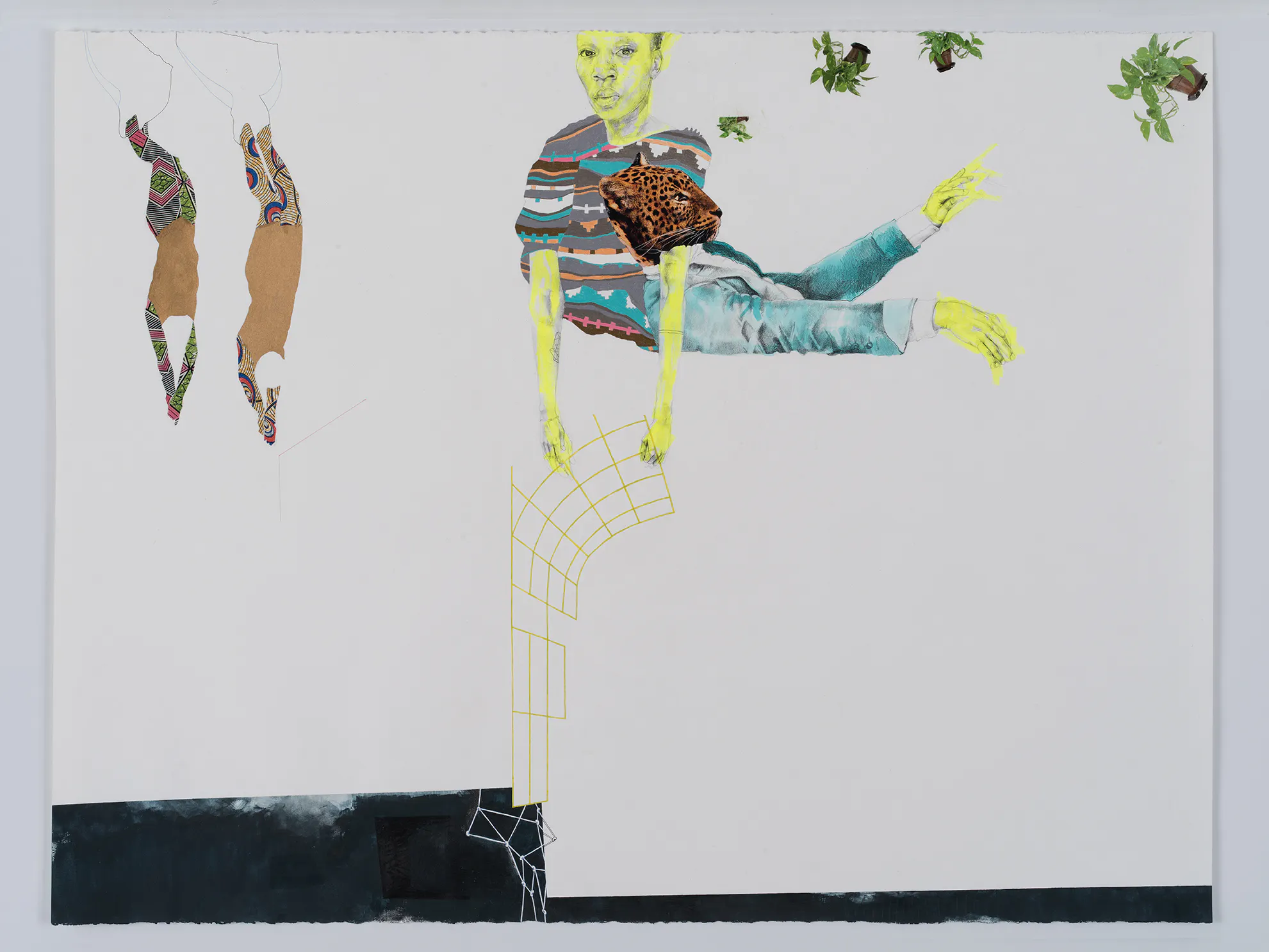
ruby onyinyechi amanze, The Divers, 2016. Graphite, ink, photo transfers, fluorescent acrylic, and colored pencils on paper, 38 × 50 in. The Studio Museum in Harlem; Museum purchase with funds provided by Nancy Lane 2016.29. Photo: John Berens