Hayward Oubre
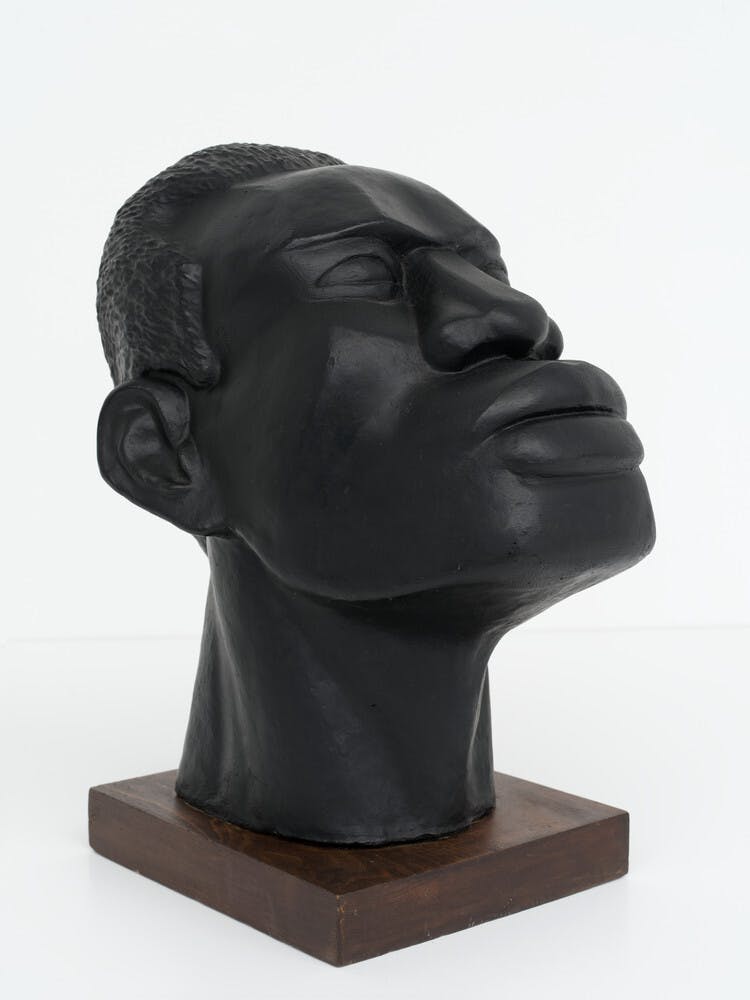
(1916–2006)As an innovative modernist and trailblazing educator, Hayward Oubre influenced Black Southern artists, expanding the possibilities of material, color theory, and artistic training within historically Black institutions.
Biography
Born and raised in New Orleans, in 1939 Oubre was the first person to graduate from Dillard University with a BFA degree. He continued his artistic training at Atlanta University (now Clark Atlanta University), where he studied under Hale Woodruff. His postgraduate studies were interrupted when he was drafted into World War II and placed in the 97th Regiment in Alaska, an all-Black unit tasked with building a military highway. The design, drawing, and construction experience gained from his service would later influence Oubre’s approach to structure, form, and material in his artistic practice. After completing his service, Oubre earned a MFA from the University of Iowa.
Oubre returned to the South and invested in the education of artists at historically Black colleges and universities. He taught at Florida A&M University before helping establish the art department at Alabama State University (ASU) in 1949. During his tenure at ASU, Oubre began manipulating wire coat hangers to create sculptures, a material that became central to his artistic legacy.
In 1965 Oubre left ASU to help establish the art department at Winston-Salem State University (WSSU). While teaching, Oubre conducted independent research on Johann Wolfgang von Goethe’s color triangle theory: a three-layered model that categorized colors based on thier physical and emotional attributes. Oubre corrected this theoretical concept and developed a four-intensity color wheel, which he trademarked in 1975.
Oubre retired as the Chair of the Art Department at WSSU in 1981 but continued to assist the Art Department with the handling of a donated collection from Selma Burke and as a curator of the Selma Burke Gallery.
Oubre’s work entered Studio Museum in Harlem collection in 2003. His work is also in the collections of the Metropolitan Museum of Art, the High Museum of Art, and more. A retrospective of his work, Hayward Oubre: Structural Integrity, has been shown at the Stanley Museum of Art, Birmingham Art Museum, and the New Orleans Museum of Art.
Exhibitions and Events
Hayward Oubre
(1916–2006)As an innovative modernist and trailblazing educator, Hayward Oubre influenced Black Southern artists, expanding the possibilities of material, color theory, and artistic training within historically Black institutions.
Stevedore, 1945
Biography
Born and raised in New Orleans, in 1939 Oubre was the first person to graduate from Dillard University with a BFA degree. He continued his artistic training at Atlanta University (now Clark Atlanta University), where he studied under Hale Woodruff. His postgraduate studies were interrupted when he was drafted into World War II and placed in the 97th Regiment in Alaska, an all-Black unit tasked with building a military highway. The design, drawing, and construction experience gained from his service would later influence Oubre’s approach to structure, form, and material in his artistic practice. After completing his service, Oubre earned a MFA from the University of Iowa.
Oubre returned to the South and invested in the education of artists at historically Black colleges and universities. He taught at Florida A&M University before helping establish the art department at Alabama State University (ASU) in 1949. During his tenure at ASU, Oubre began manipulating wire coat hangers to create sculptures, a material that became central to his artistic legacy.
In 1965 Oubre left ASU to help establish the art department at Winston-Salem State University (WSSU). While teaching, Oubre conducted independent research on Johann Wolfgang von Goethe’s color triangle theory: a three-layered model that categorized colors based on thier physical and emotional attributes. Oubre corrected this theoretical concept and developed a four-intensity color wheel, which he trademarked in 1975.
Oubre retired as the Chair of the Art Department at WSSU in 1981 but continued to assist the Art Department with the handling of a donated collection from Selma Burke and as a curator of the Selma Burke Gallery.
Oubre’s work entered Studio Museum in Harlem collection in 2003. His work is also in the collections of the Metropolitan Museum of Art, the High Museum of Art, and more. A retrospective of his work, Hayward Oubre: Structural Integrity, has been shown at the Stanley Museum of Art, Birmingham Art Museum, and the New Orleans Museum of Art.